
What are the differences between the weBoost Office 200 and the HiBoost CommLink 20K?
Updated
In this review, we’ll compare the weBoost Office 200 (472047, 471047) with the new HiBoost CommLink 20K (Pro25T‑5s‑BTW).
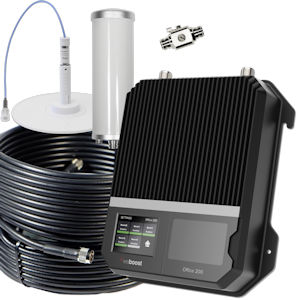 weBoost Office 200
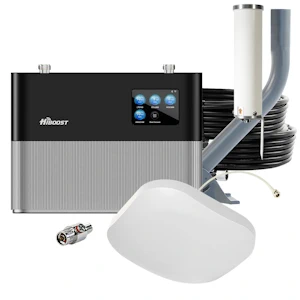 HiBoost CommLink 20K
These professional-grade cell signal boosters improve indoor cell reception in offices, retail spaces, and other commercial buildings, and both cover about the same indoor area for the same price. Which one is right for you? Let’s explore their similarities and their differences.
Where they’re the same
The weBoost Office 200 and the HiBoost CommLink 20K share most of their core specifications. These include:
- Cellular frequencies supported:
- 700 MHz (Band 12/17, Band 13)
- 850 MHz (Band 5)
- 1700/2100 MHz (Band 4)
- 1900 MHz (Band 2/25)
- Open-space indoor coverage: Up to about 20,000 ft2 (with strong outside signal)
- Maximum gain: 72 dB (the maximum for a Part 20 consumer booster)
- Maximum downlink power: About 15 dBm
- Impedance and connectors: 50 ohm with N connectors
- Amplifier design: Wall-mountable metal housing with top-mounted connectors
- Display: Color LCD touchscreen
- Gain control: Automatic (AGC)
- Certifications: FCC and carrier preapproval (no operating license required)
Both units are Part 20 consumer amplifiers that operate at the maximum 72 dB gain permitted by the FCC, on the major frequency bands that carry the backbone of U.S. cellular service. Their N‑female connectors sit on top of the amplifier, so coax runs drop straight in for a clean, quick install.
From Powerful Signal, both kits ship with a similar set of components: a wideband outdoor omnidirectional antenna, a low-profile inside dome antenna, low-loss 400-type coax, a 50-ohm lightning surge protector, and an AC/DC power supply. The HiBoost CommLink 20K also offers a directional LPDA outside antenna and an indoor panel antenna as kit options.
Where they differ
Amplifier size & weight
- weBoost Office 200: 14.25″ w × 10.75″ h × 2.25″ d × 7.7 lbs. (36.2 cm w × 27.3 cm h × 5.7 cm d × 3.49 kg)
- HiBoost CommLink 20K: 9.3″ w × 6.9″ h × 2.0″ d × 3.09 lbs. (23.6 cm w × 17.4 cm h × 5.0 cm d × 1.4 kg)
The HiBoost CommLink 20K takes up about a third of the volume and weighs under half as much as the weBoost Office 200. If wall space is tight, or you want a more discreet installation, the smaller, lighter HiBoost is easier to place and mount.
Per-band gain control
- weBoost Office 200: Bands on or off (automatic gain, XDR overload protection)
- HiBoost CommLink 20K: Automatic plus manual per-band gain trim (MGC)
Both boosters manage gain automatically, and both handle bands that come in too strong with robust overload and oscillation protection—weBoost markets its version as patented XDR (eXtended Dynamic Range), while the HiBoost uses its own automatic overload and oscillation safeguards. In practice we’ve found the HiBoost’s overload protection to be every bit as capable as weBoost’s.
The difference is what happens when you want to step in by hand. On the weBoost Office 200, an installer can turn individual bands on or off, but the gain on each band is set automatically and can’t be dialed partway. The HiBoost CommLink 20K adds manual gain control on top of its automatic mode: from the touchscreen (or the Signal Supervisor app), an installer can trim the gain of each band individually—up to 25 dB of attenuation in 1 dB steps. In tricky RF environments where one band is overpowering, that per-band fine-tuning gives installers precise control that the Office 200 doesn’t offer.
Remote monitoring
- weBoost Office 200: On-unit touchscreen only
- HiBoost CommLink 20K: Touchscreen plus Signal Supervisor app & web portal
The HiBoost CommLink 20K connects to HiBoost’s Signal Supervisor platform (iOS, Android, and web), so you can check status, view live diagnostics, and adjust gain remotely without standing at the amplifier. The weBoost Office 200 is configured and monitored from its on-unit touchscreen.
Impedance & connector options
- weBoost Office 200: 50 ohm (N) or 75 ohm (F)
- HiBoost CommLink 20K: 50 ohm (N) only
The weBoost Office 200 comes in a 50-ohm version (472047, N connectors, 400-type coax) and a 75-ohm version (471047, F connectors, RG‑11 coax). If your building is already wired with 75-ohm cable, the 75-ohm Office 200 drops right in. The HiBoost CommLink 20K is 50-ohm only, which is the standard for most new commercial booster installs.
Which one should you choose?
The weBoost Office 200 and the HiBoost CommLink 20K are both excellent 72 dB commercial boosters that cover about 20,000 square feet at the same price, so the right choice comes down to a few details:
- Choose the HiBoost CommLink 20K if you want a smaller, lighter amplifier that’s easier to mount, per-band manual gain fine-tuning for tricky signal environments, and remote monitoring from your phone or the web.
- Choose the weBoost Office 200 if you need a native 75-ohm option for existing F/RG‑11 wiring, or you prefer the weBoost/Wilson Electronics ecosystem.
Need help choosing the best commercial cellular amplifier solution?
The experts at Powerful Signal have been improving cellular reception in buildings of all sizes since 2007. Please call us at 435-634-6800 or contact us online—we’ll be happy to help you find the best system to improve cellular reception in your office or commercial building.