


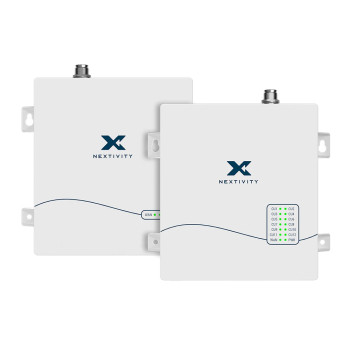


The CEL-FI QUATRA 100M is Nextivity’s most advanced single-operator enterprise DAS, engineered to bring full 5G Standalone and Non-Standalone C-Band coverage to large, complex facilities. From manufacturing floors and hospitals to schools and high-rise office towers, the QUATRA 100M delivers wall-to-wall 5G where it matters most.
Large commercial buildings present a fundamental challenge: thick concrete walls, steel framing, Low-E glass, and multi-story construction block the 5G signals that workers, tenants, students, and visitors rely on. Dead zones aren’t just an inconvenience—they create safety risks, interrupt operations, and prevent businesses from fully leveraging next-generation connectivity.
The QUATRA 100M solves this with a carrier-grade distributed antenna system that captures the operator’s signal at the rooftop, amplifies it, and distributes it to Coverage Units located throughout the building. Each CU rebroadcasts a strong, clean 5G signal throughout its zone. The result is seamless, high-speed 4G and 5G everywhere in the building.
Powered by Nextivity’s proprietary IntelliBoost® technology, the QUATRA 100M automatically configures every 5G parameter—gain, power levels, uplink muting, channel selection—so it’s network-safe from the moment it’s turned on. No manual RF tuning. No carrier coordination headaches. No licensing required to install or operate.
The QUATRA 100M uses a three-layer architecture—donor capture, fiber distribution, and indoor rebroadcast—to extend carrier-grade 5G throughout any building.
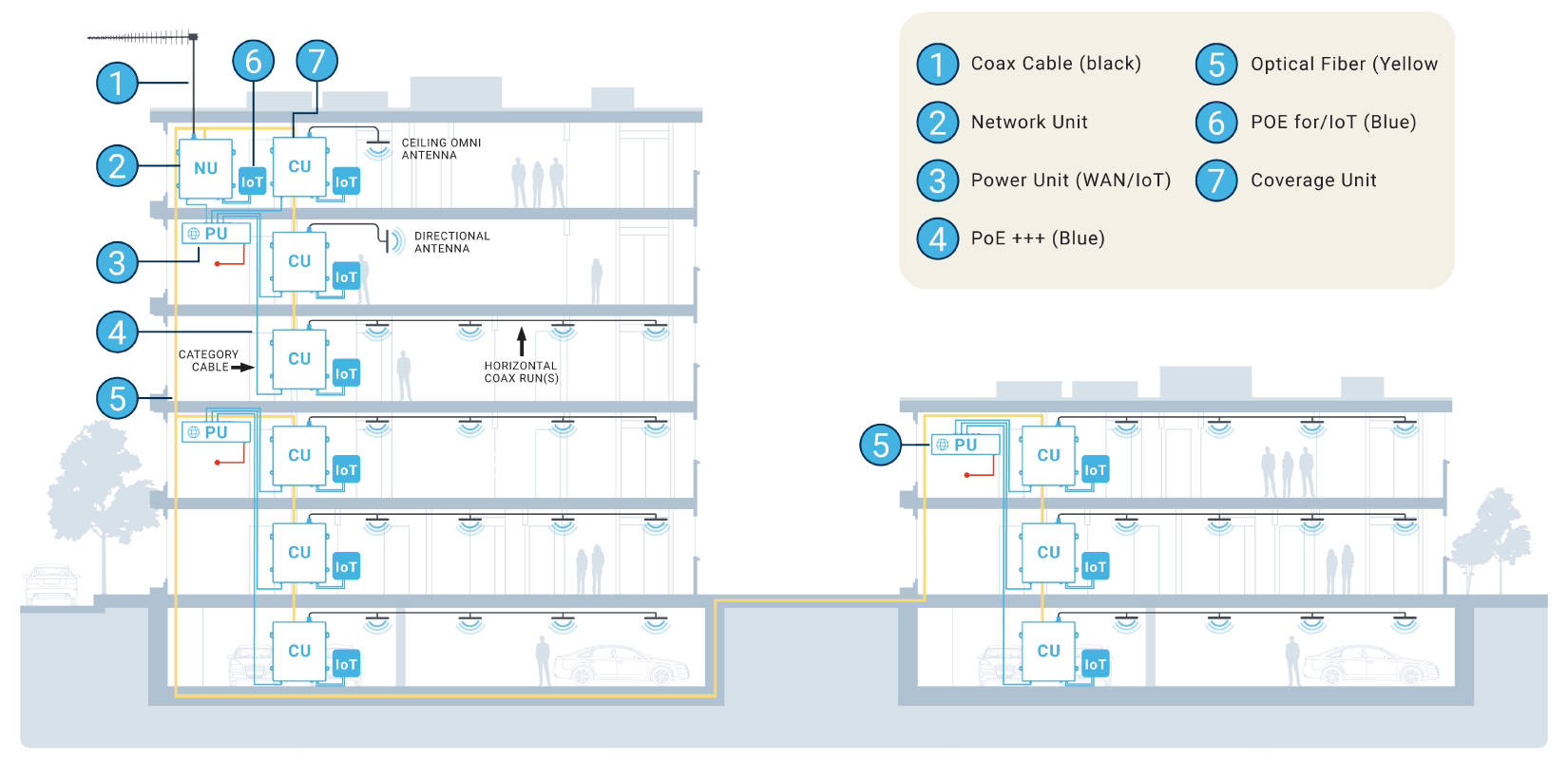
This diagram shows the most extensive layout possible for a CEL-FI QUATRA 100M system. A QUATRA 100M system in a small business or large home would involve fewer components. (Click to enlarge.)
A directional antenna installed on the rooftop (or another location with a clear line of sight to a cell tower) captures the carrier’s outdoor 5G signal. One donor antenna is required per carrier. This antenna connects to the Network Unit via coax cable.
The Network Unit (NU) is the intelligence center of the system. Powered by IntelliBoost®, it amplifies the donor signal and automatically optimizes gain and power settings to protect the carrier’s uplink. The NU then distributes the amplified signal over fiber cables to up to four directly connected Coverage Units.
Unlike earlier DAS architectures that use coaxial cables between the head-end and remote units, the QUATRA 100M uses lossless fiber distribution. Fiber carries the signal without attenuation, meaning the system can span any distance within a building—basement to rooftop, building A to building B—without signal loss.
Each Coverage Unit (CU) receives the fiber signal, converts it back to RF, and rebroadcasts it through 4–7 server antennas mounted in the ceiling. Coverage Units are powered by Power over Ethernet (PoE+), so no dedicated AC power outlet is needed at each CU location. Each primary CU can also daisy-chain two additional CUs, yielding up to 12 total CUs per Network Unit and up to 84 server antennas per system.
The QUATRA 100M transforms your in-building DAS into a dual-purpose network that delivers 5G cellular coverage and IoT connectivity simultaneously, with no separate dedicated IoT wiring required.
Every Coverage Unit includes two dedicated Ethernet ports for connecting IoT devices directly to the network. Sensors, cameras, badge readers, environmental monitors, and other IP-connected devices plug directly into the CU, leveraging the existing fiber backbone without any additional cabling runs.
This dramatically reduces the cost of deploying IoT across a large facility. Instead of running separate network drops to every sensor location, the IoT devices connect at the nearest Coverage Unit.
The Nextivity SMART SERVER ANTENNA (model A91-JV4-C00) replaces standard passive server antennas with an active, intelligent unit. In addition to broadcasting 5G cellular signal in all directions (450–4200 MHz, 360° omnidirectional), the SMART SERVER ANTENNA includes:
The QUATRA 100M’s built-in IoT infrastructure—combined with Nextivity’s Panic Button Service and SMART SERVER ANTENNAs—provides schools with a turnkey pathway to compliance with Alyssa’s Law in every state where it has been enacted.
Alyssa’s Law is named after Alyssa Alhadeff, a 14-year-old student killed in the February 14, 2018, Parkland, Florida school shooting. Her mother, Lori Alhadeff, channeled her grief into advocacy, championing legislation that requires schools to install silent panic alarm systems that connect directly to law enforcement, bypassing internal phone trees and reducing first-responder response time.
The core insight behind Alyssa’s Law is simple but powerful: In an active threat situation, every second of law enforcement response time saved saves lives. Traditional school emergency procedures—calling the front office, who calls 911, who dispatches emergency responders—introduce dangerous delays. A silent panic button that transmits directly to a 911 PSAP (Public Safety Answering Point) eliminates those delays.
WiFi networks become severely congested during mass emergency events when hundreds of devices simultaneously attempt to connect. Cellular DAS networks are engineered for higher capacity and are unaffected by this congestion—ensuring the panic button signal gets through even during a full-building emergency with maximum simultaneous device activity. Additionally, the QUATRA 100M eliminates the dead zones in basements, stairwells, gyms, and portables where WiFi coverage is typically weakest and where threat actors are most likely to exploit coverage gaps.
Nextivity’s Panic Button Service is a Solution-as-a-Service (SaaS) add-on that converts the QUATRA 100M’s DAS infrastructure into a dual-purpose safety network. Here is what happens from the moment a staff member activates a panic button:
The CEL-FI QUATRA 100M is an enterprise-grade system that requires professional RF design and installation. Powerful Signal’s engineering team works directly with facility managers and IT teams to design a system that achieves maximum coverage with the fewest components.
Every QUATRA 100M project begins with a professional system design. Powerful Signal's RF engineers review your building floor plans and, where possible, conduct an on-site signal survey to understand the available donor signal strength at potential rooftop antenna locations. From that data, we specify:
Our goal is always the fewest number of components needed to achieve the maximum amount of coverage—keeping your project cost-effective without compromising coverage quality.
Call Powerful Signal at 435-634-6800 or request a free custom quote online. We’ll design a custom system that will solve your cellular reception and connectivity problems at the best possible price point. We’ve designed thousands of cell signal amplifier systems—let us create one for you!
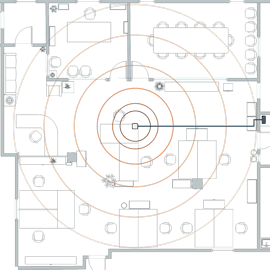 An office floor with amplified cellular signal from a CEL-FI QUATRA 100M Coverage Unit (CU) with one dome antenna.
For information on federal rules governing the use of consumer cell signal boosters, please see our FCC notice page.
 Warning This product can expose you to chemicals, including nickel, which is known to the State of California to cause cancer, and Bisphenol A, which is known to the State of California to cause birth defects or other reproductive harm. For more information go to www.P65Warnings.ca.gov
 .
.
Product Specifications
Warranty Information
For warranty information on this product, please see our Nextivity warranty information page.
Questions & Answers